

The Mythmaker's Trap: When Intelligence Becomes Isolation
When your books fail, you're not a failure.

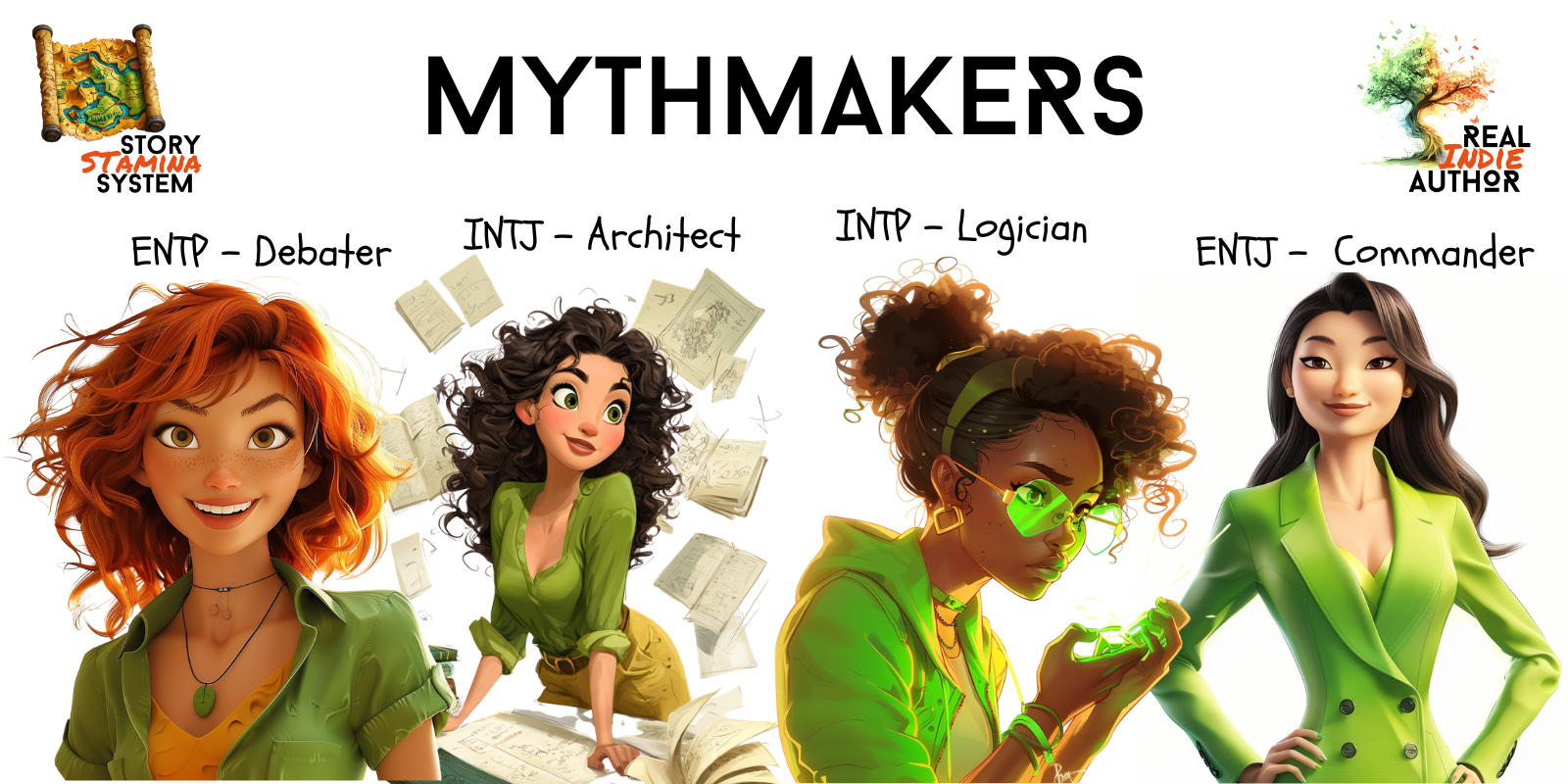
When I’m having a crappy day, I love to sit down and develop a new system, or tweak an existing one, or build a strategy, or pour of analytics, or search for patterns in genre, trope, voice—whatever. I love pattern searches, solution architecture, and strategy. I just also love it when those same systems have a beating heart and a thriving soul.
Working with Mythmakers was a little frustrating at first because I was tasked with providing them an outline and every single one I wrote was wrong. Every single one. I fell onto my Heartweaver soul sword and cried actual tears, wondering what I’d done wrong and how I’d ever make it anywhere as anything if I couldn’t get a single outline done right.
Mythmakers are curious people. They go out and take a million classes, complete very few of them, collect the information, and then create systems from all of them that make sense… to them.
And sometimes, we’re a little irritating when we’re information gathering.
We’re not here to participate in broken systems. We laugh in the face of, “I make millions of dollars doing X. Follow me and you can do the same,” because we know it’s complete B.S. Sure! You made millions. On accident. Sure! Others could follow you, but they’ll only succeed if they’re you or extremely like you. But do you understand your system well enough to give them the parts and pieces and how to craft it for success in their individuality?
Probably not.
Which is why we take your $47 class and we cry B.S. at your slides while doing what you couldn’t; finding ways to take your information and craft it for individuality.
Why? Because we fix problems. That’s who we are. We can’t help it.
And that’s… precisely where the trouble starts.
The Structure Struggle: Living in Theory Instead of Traction
Mythmakers don’t hate structure. We hate inefficient structure.
If the system makes sense, we’ll optimize it. If it doesn’t, we’ll dismantle it. If it’s mediocre, we’ll redesign it from scratch.
That’s our gift.
But here’s the trap:
We can spend years perfecting frameworks we never deploy.
When did I officially launch the Story Stamina System? April of 2024? What month is it now? February of 2026. Do you know what I did in the two years since I launched this?
I refined it.
I strategized it.
I modeled outcomes.
I mapped contingencies.
We build the most brilliant publishing machine that never leaves the garage. Because implementation feels… crude, but system creation feels amazing!
Do you have any idea how many worlds I have built but never actually wrote in? That’s one reason I felt comfortable selling concepts and outlines. I had so many I, personally, was never going to deploy because… who has that kind of time?!
Execution is messy.
People are irrational.
Markets don’t behave logically.
Readers don’t buy based on clean spreadsheets.
And that irritates us.
So instead of entering the chaos, we retreat to the lab where we understand the rules and the world makes sense.
Over-Engineering the Path to Success
Mythmakers do not copy trends. We are the exact opposite of Lorekeepers. We always ask questions. We’ll jump on the first thing that makes sense or connects and we’ll run with it, sometimes in the wrong direction, but that’s valuable too. Information and data are our gold.
We reverse engineer everything. I can’t tell you the last thing I didn’t reverse engineer. I do this to books, songs, programs, systems—okay. Cars. I don’t reverse engineer those. Or mechanical… anything. Saws. Tools. Intellectual properties. I reverse engineer those.
We study:
Why that launch worked
Why that trope hit
Why that ad converted
Why that funnel scaled
And then we build something smarter, cleaner, more efficient, more “correct.”
The problem?
Publishing is not a purely logical ecosystem. Ever. Like… ever.
You cannot optimize human emotion the way you optimize code.
Mythmakers will delay shipping for six months to improve a structure that readers would have been perfectly happy with at version 1.0.
Perfection becomes procrastination in a tuxedo.
Emotional Avoidance Disguised as Rationality
Mythmakers pride themselves on logic. But what we often call “objectivity” is actually emotional distance. Imagine being this person as a Heartweaver. Hehe… haha.. OMG. It’s… awful.
If a launch fails, we say, “Interesting. The variables were misaligned.” Unless you’re a Heartweaving Mythmaker and then you say that after you’ve spent two days mourning the loss of your soul because you’re empty, worthless, and should never have tried this.
If reviews sting, we say, “Statistically insignificant sample size.” Or… “Obviously not your target reader. Where did your marketing go wrong?”
If sales drop, we say, “The market shifted. What metric did I miss?”
We analyze instead of feel. Well, true Mythmakers do that. If we’re a hybrid, we do the other thing and then, hopefully, if we’re lucky, fall back on this.
And that works… until it doesn’t.
Because at some point, you are not running a theory experiment. You are building art. And art requires vulnerability.
Mythmakers can accidentally intellectualize themselves out of resonance.
The Lone Wolf Illusion
Mythmakers are deeply independent, and I envy the true Mythmakers for this. As a Heartweaving Mythmaker, I’m not nearly as independent as I want to be.
They don’t need approval—and I typically don’t… until my Heartweaver half kicks in and then I’m like a kicked puppy.
They don’t need hype—and I typically don’t until my Heartweaver half sniffles for it.
They don’t need community to function. Do you have any idea how much simpler my career would be if I was a full-fledged Mythmaker? The Heartweaver part of me craves a community I can’t seem to build because my Mythmaking side doesn’t check into the community side of things often enough to build anything.
But here’s the quiet cost:
We can isolate ourselves so thoroughly that no one is close enough to challenge us. And! And… few do challenge us because we appear to know what we’re doing.
We debate in our heads.
We simulate arguments.
We pre-empt criticism.
But we don’t invite real friction from the outside.
And friction is what sharpens strategy.
Many Mythmakers stall not because they lack intelligence —but because they refuse collaboration that might disrupt their intellectual authority.
Analysis Paralysis
Mythmakers are addicted to improvement. Yeah. OMG. That’s so real. We can always see a smarter positioning angle, a better genre hybrid, a tighter theme, a more scalable release cadence.
So we adjust.
And adjust.
And adjust.
Instead of publishing.
Instead of marketing.
Instead of repeating.
Remember this:
A slightly imperfect system repeated 100 times beats a brilliant system deployed once.
Mythmakers build empires in their heads.
Careers are built in repetition.
And, yes, I italicized that so I would listen to myself.
Burnout Through Mental Overextension
Wildscribes burn out from scattered energy.
Heartweavers burn out from emotional depletion.
Lorekeepers burn out from loyalty to the wrong blueprint.
Mythmakers?
We burn out from thinking. No. No. Stay with me.
Constant modeling.
Constant optimizing.
Constant future-mapping.
Our brains never shut off. Ever. In the shower? It’s thinking about that Instagram post that never got a single like. Was it the color? The font? The message? What if it was turned into a Reel? What’s the deal with Stories? Do those even make sense? What if it was turned into an excerpt of the story? Would that do better?
And because thinking feels productive, we don’t realize we’re exhausted until we can’t create at all.
We aren’t tired from work.
We’re tired from simulation—which… is still work.
Closing Advise
If you’re a Mythmaker, you’re motivated by truth, mastery, autonomy, intellectual challenge, systems that make sense, and long-term strategic dominance. We’re not motivated by chasing trends that will fade before we’ve had a chance to develop a strategy to serve it, or emotional hype.
In order for you to succeed in creating a sustainable indie author career, stop redesigning the road. Walk it. You don’t burn out because you lack discipline. You burn out because you mistake refinement for progress.
Brilliance deployed imperfectly wins over brilliance protected.
Now go build something that exists outside your head.
